 Menu
Menu


-
Experiences
-
Experiences
-
Posters
Menu
-
Categories
-
Places
Menu
- Galleries LICHT Gallery ExpoGeorgia IArt Gallery Dimitri Shevardnadze National Gallery Tbilisi Digital Space
- City sites Mtatsminda Park Mziuri Park Vake Park April 9 (Alexander) garden Shota Rustaveli Avenue
- Children's studios Creative center Art BOOM Tamashobana Happy Kids Art Club Ferdinand farm GinGer
- Ecclesiastical institutions Tbilisi Yoga Loft TBILISI YOGA VILLA Transcendental Meditation Georgia Lumos Yoga Cave
- Event spaces KERA Space Gardenia Shevardnadze Orbeliani Bazaar Fabrika bibliotheque_tbilisi
- Cafe-restaurants Blue Fox Restaurant Tsiskvili Utskho 8000 Vintages Wasserstrasse
- Cinemas Amirani Cinema Cavea City Mall Saburtalo Cavea Grand Mall Cavea Tbilisi Mall Cavea East Point Cavea Galleria
- Concert halls Kakhidze Music Center Monohall MONUMENT Tbilisi Concert Hall Tbilisi Sports Palace
- Lecture halls Terminal Auditoria Colab TBC Concept PRANA
- Museums Georgian Museum of Fine Arts Georgian National Museum Experimentorium Holoseum Zurab Tsereteli Museum of Modern Art
- Nightclubs/bars Love Bar Underwheel club Dedaena Bar KHIDI MTKVARZE
- Educational institutions Institut Français de Géorgie Beka's School BTU The Thinking Academy Japanese Language & Culture Center
- Public organizations Georgian Historic Vehicles Association Georgian-Ukrainian platform (Ukrainian House) The Samaritan Association of Georgia Blood Bank
- Hotels Tbilisi Hills & Residence Pullman Tbilisi Axis Towers Stamba Hotel Sheraton Grand Tbilisi Metechi Palace Holiday Inn Tbilisi
- Sports grounds Dinamo Arena Mikheil Meskhi Stadium Hippodrome Lisi Lake Lilo Arena Paichadze Stadium
- Theaters Nodar Dumbadze Theater (ნოდარ დუმბაძის თეატრი) Tbilisi Circus Royal District Theatre Griboedov Theatre Gabriadze Theatre
-
Categories
-
Posters
-
Categories
-
Places
Menu
- Galleries LICHT Gallery ExpoGeorgia IArt Gallery Dimitri Shevardnadze National Gallery Tbilisi Digital Space
- City sites Mtatsminda Park Mziuri Park Vake Park April 9 (Alexander) garden Shota Rustaveli Avenue
- Children's studios Creative center Art BOOM Tamashobana Happy Kids Art Club Ferdinand farm GinGer
- Ecclesiastical institutions Tbilisi Yoga Loft TBILISI YOGA VILLA Transcendental Meditation Georgia Lumos Yoga Cave
- Event spaces KERA Space Gardenia Shevardnadze Orbeliani Bazaar Fabrika bibliotheque_tbilisi
- Cafe-restaurants Blue Fox Restaurant Tsiskvili Utskho 8000 Vintages Wasserstrasse
- Cinemas Amirani Cinema Cavea City Mall Saburtalo Cavea Grand Mall Cavea Tbilisi Mall Cavea East Point Cavea Galleria
- Concert halls Kakhidze Music Center Monohall MONUMENT Tbilisi Concert Hall Tbilisi Sports Palace
- Lecture halls Terminal Auditoria Colab TBC Concept PRANA
- Museums Georgian Museum of Fine Arts Georgian National Museum Experimentorium Holoseum Zurab Tsereteli Museum of Modern Art
- Nightclubs/bars Love Bar Underwheel club Dedaena Bar KHIDI MTKVARZE
- Educational institutions Institut Français de Géorgie Beka's School BTU The Thinking Academy Japanese Language & Culture Center
- Public organizations Georgian Historic Vehicles Association Georgian-Ukrainian platform (Ukrainian House) The Samaritan Association of Georgia Blood Bank
- Hotels Tbilisi Hills & Residence Pullman Tbilisi Axis Towers Stamba Hotel Sheraton Grand Tbilisi Metechi Palace Holiday Inn Tbilisi
- Sports grounds Dinamo Arena Mikheil Meskhi Stadium Hippodrome Lisi Lake Lilo Arena Paichadze Stadium
- Theaters Nodar Dumbadze Theater (ნოდარ დუმბაძის თეატრი) Tbilisi Circus Royal District Theatre Griboedov Theatre Gabriadze Theatre
Posters
-
Categories
Event already passed
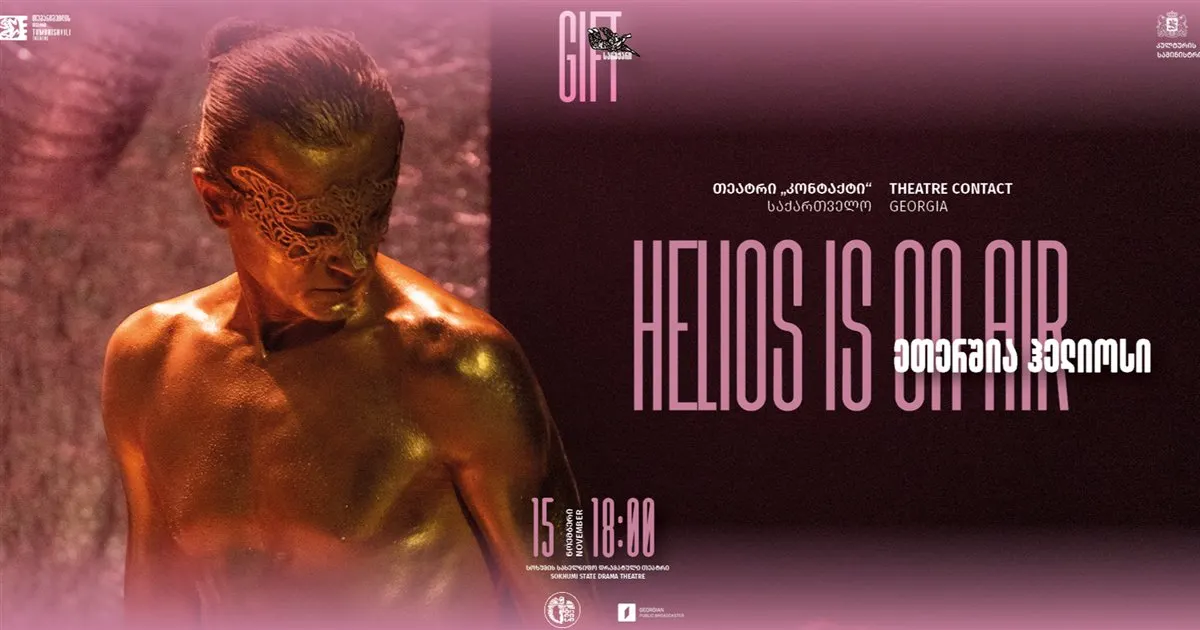
Etershia Heliosi
Etershia Heliosi
68, Dimitri Uznadze Street, Tbilisi
Ticket price
from20 ₾
Description
This story, on the one hand, tells about the mythological sun god Helios, but at the same time it has nothing to do with Greek myth. In the play, Helios does not represent a person or a personality, he is only a symbolic key to a person in a vacuum of thought on the path to self-knowledge.
The main action takes place in a room with mirrors in a simulated world, where the population is in a zombified, “sleeping” state. A TV and radio announcer provides emergency information to people glued to their screens that “Helios” may appear in their world and calls on the population to be careful.
Confusion is observed among the members of the society. They react to this information in different ways and have different expectations for the appearance of Helios. Some of them see salvation in the appearance of the Messiah.
The features of the crisis state of society locked in a digital room are shown: stagnation, internal chaotic and turbulent feelings, conflict with oneself and with each other, arrogance, a feeling of inner emptiness, duplicity, and naivety that manifests itself in everyday life. Against the backdrop of a psychological crisis, members of the population offer each other personal growth services and profane service.
Despite this, a small part of people feels and understands the mental traps and illusions present in the room. Values are reevaluated and attempts at self-reflection occur.
The screen suddenly stops broadcasting. After that, interest in the appearance of Helios becomes even more intense and reaches a climax.
Photos and videos
Location

Sokhumi State Drama Theatre founded in 1885 is a refugee company from Abkhazia. It is based in Tbilisi
All events at this location
Sign up for the newsletter